There is a small face on Michael Manning’s desk that can look delighted, alarmed, chilly, or thoroughly unimpressed by the room. Give it a pleasant temperature and it smiles. Let the air wander toward an extreme and the expression changes. It is a charming bit of theater from a device with the wonderfully awkward name Weathergotchi.
The trick is refreshingly honest: fixed temperature thresholds choose the face. Weathergotchi is not AI, does not learn anyone’s habits, and does not fetch a forecast. It measures the conditions immediately around it, records them locally, and gives those numbers a little personality.
A room sensor with comic timing
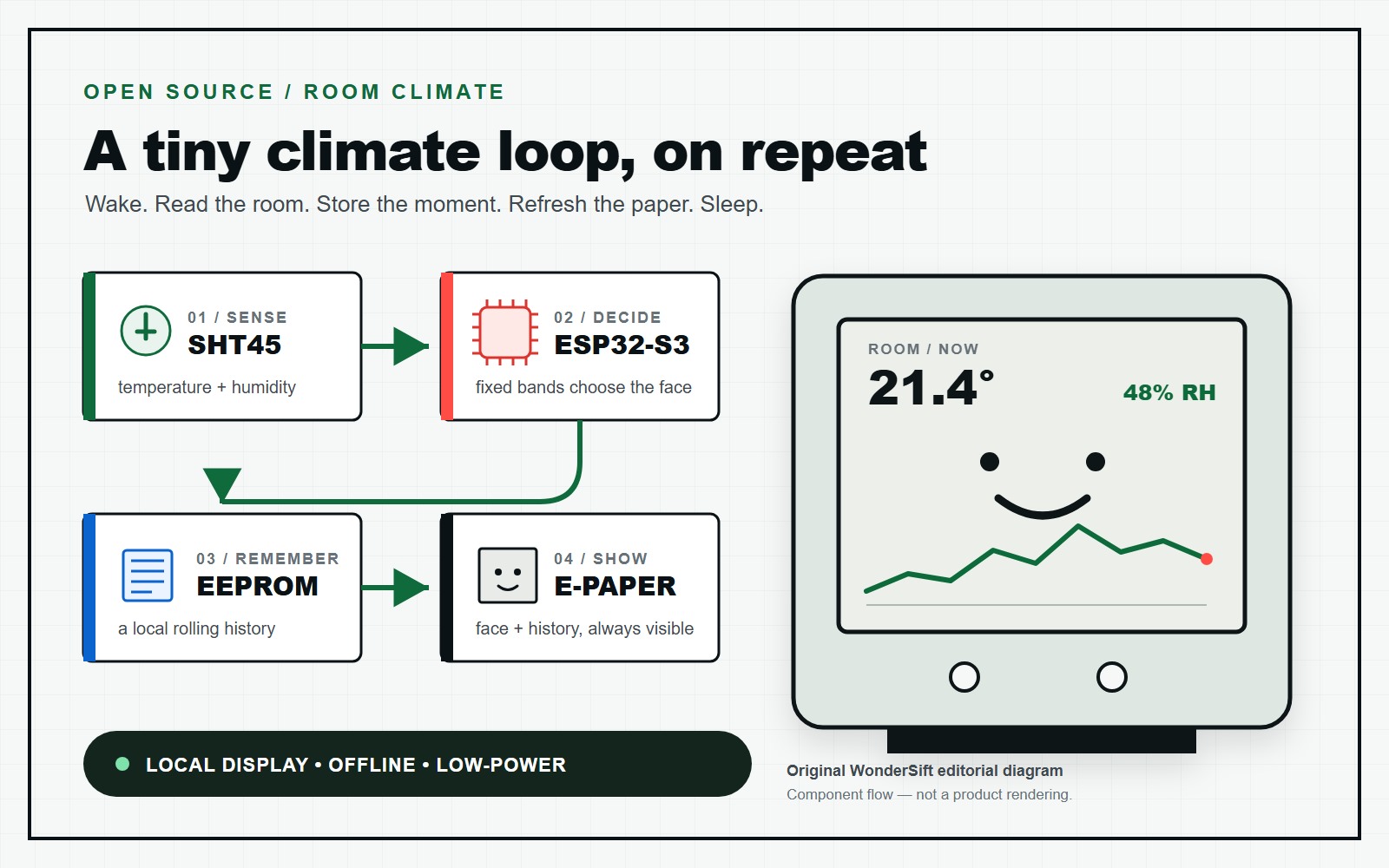
Most climate monitors communicate like tiny accountants: 22.4 degrees, 48 percent humidity, next question. Weathergotchi keeps the numbers but adds an expressive shortcut. The current firmware walks through a series of Celsius comparisons, selecting a bitmap face for cold, comfortable, warm, or hot conditions. The character is a readable gauge, not a claim that the box has feelings.
The screen also shows humidity, time, battery status, and recent history. Buttons let a curious owner page through older readings and switch views, while settings cover Celsius or Fahrenheit, 12- or 24-hour time, graph range, refresh interval, and a night-screen mode. Because e-paper holds an image without continuous power, the face can remain visible while the processor rests.
That combination is the appeal. A number tells you the room is warm; a tiny overheated expression catches your eye from across the desk. It makes invisible drift—an afternoon sunbeam, a stuffy meeting, a heater working overtime—feel like an event.
What happens between blinks
Under the printed enclosure is a serious maker project. A Sensirion SHT45 measures temperature and relative humidity. An ESP32-S3 microcontroller coordinates the reading, interface, and display. A 24LC512 EEPROM keeps the log when power is removed, while a DS3231 real-time clock maintains time and can wake the processor. A BQ27441 fuel gauge watches the battery. Manning designed a custom circuit board and published the printable case files alongside the firmware and schematics.
The face is selected by predefined temperature ranges. It does not learn, infer emotion, or consult an online weather service.
In normal use, the clock wakes the ESP32-S3 at an interval, and the firmware takes a climate reading immediately. It logs the result, refreshes what needs refreshing on the e-paper panel, and returns to low-power sleep. The quick reading matters: the microcontroller itself produces heat while active, so lingering in menus or holding the case can temporarily nudge the sensor away from the room’s true ambient temperature.
Manning’s design target is more than one week on a small lithium-polymer battery. WonderSift has not tested that runtime, and processor documentation alone cannot prove it. The project gets there conceptually by making wakeful moments brief and letting the ESP32-S3 spend most of its life asleep.
The missing cloud is the feature
The ESP32 family is famous for wireless networking, yet this version deliberately offers no Wi-Fi or Bluetooth data export. History stays in the device’s memory and is reviewed on its screen. That makes it less convenient for spreadsheets and remote alerts, but wonderfully uncomplicated as an object: no app, account, subscription, server, or dashboard competing with the little face.
It also gives Weathergotchi a coherent purpose. This is not a miniature weather station predicting rain across town. It is an ambient-condition logger for the patch of air surrounding it. Place it near a plant, on a bedroom shelf, or beside a drafty window and it becomes a quiet record of that specific spot.
The offline choice has a practical battery benefit, but it also changes the mood. The gadget is there to be glanced at, not managed. Its recent-history graph supplies context without turning your room into another cloud dataset.
Still a prototype—and that is part of the fun
Weathergotchi is an open-source build, not a finished appliance with a warranty and a calibration certificate. The repository includes firmware, board design, schematics, and enclosure files, but assembly involves a custom board and small components. Its sensor has impressive manufacturer specifications; that does not mean the complete homemade device has been scientifically validated.
Manning documents the rough edges plainly. Battery-percentage reporting has been inaccurate in testing, and a nearly depleted battery can enter a state requiring disconnection and external charging. Prolonged handling can warm the reading. The e-paper module has a low-temperature operating limit, and the current code protects normal display operation before the cold becomes extreme. Logging behavior and what the screen can reliably show are not always the same thing.
None of that spoils the idea. It locates it in the most interesting part of maker culture: beyond a breadboard demonstration, short of anonymous mass production. Every layer—from case geometry to the face-selection code—is available to inspect and improve.
A friendly face for local facts
Weathergotchi succeeds because its whimsy stops exactly where the facts begin. The smile is playful; the thresholds behind it are explicit. The history is useful; it stays nearby. The processor is capable of joining the internet; the design chooses not to.
That restraint makes the project feel oddly fresh. It does one small job, makes the result pleasant to notice, and then goes back to sleep. In a world of devices desperate to become platforms, this tiny climate pet would rather sit on a shelf and judge the thermostat.