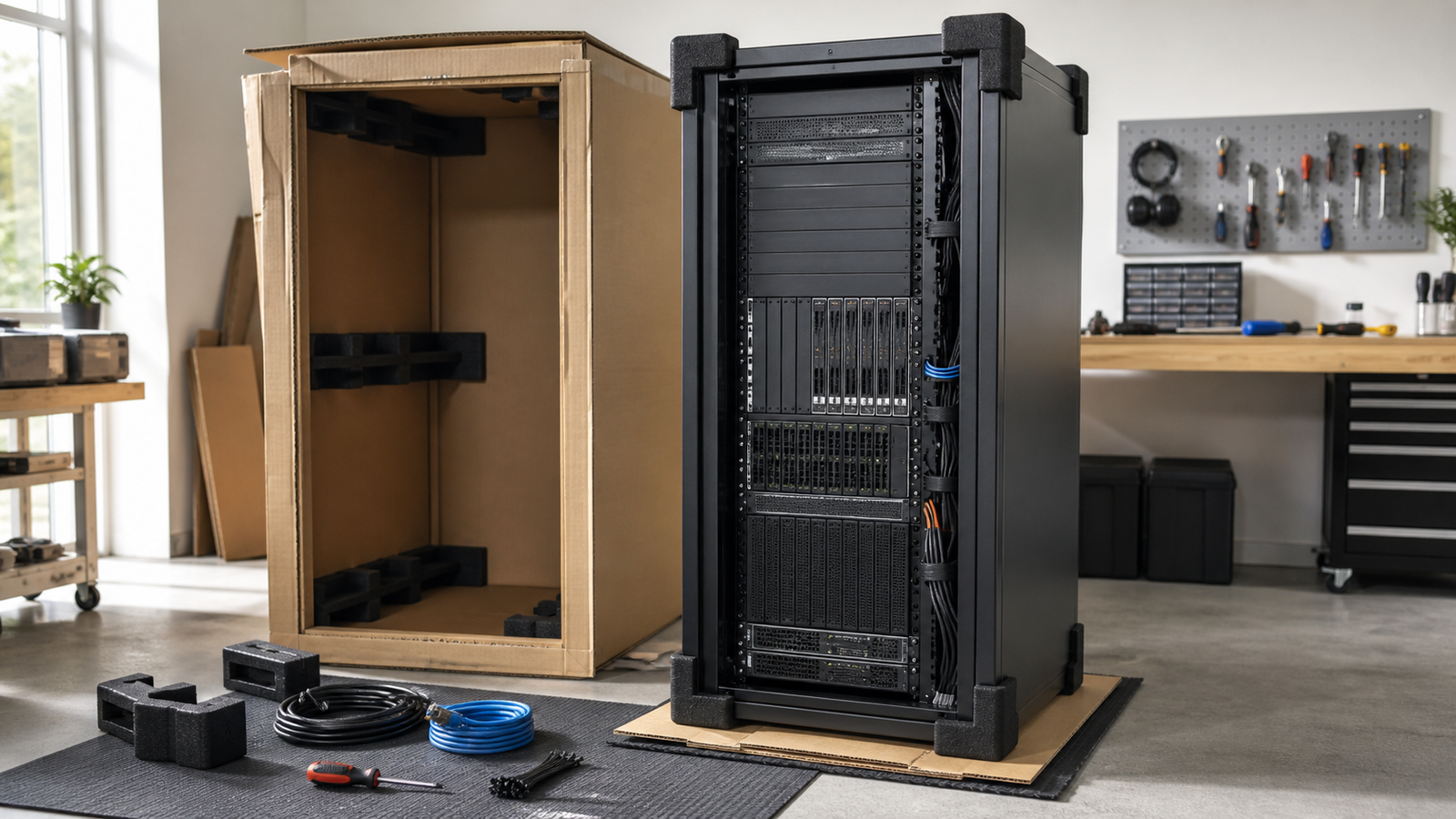
A new artificial-intelligence model arrives with the atmosphere of premium flat-pack furniture. The important pieces are in the box. The box is extremely heavy. Somewhere under the packing foam is a licence, several terabytes of learned parameters, and the dawning realization that nobody included a server room.
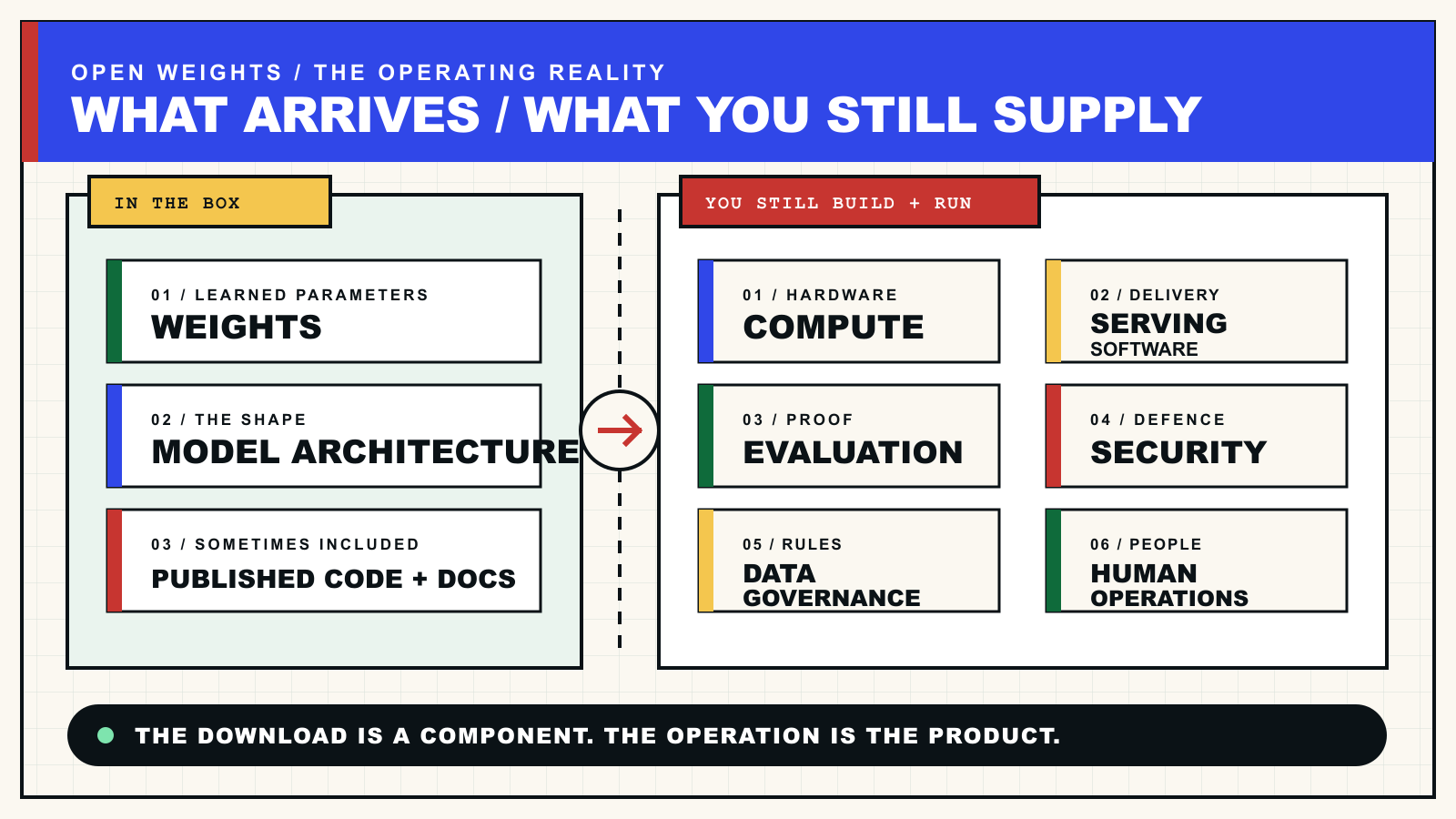
That is the useful way to understand an open-weights model. You receive the numerical parameters a trained system learned, often with code and documentation that help it run. You do not automatically receive the training data, the complete training recipe, a hosted service, a safety department, or a calm engineer who knows why rack three is making that noise.
A very large box arrives
Moonshot AI’s Kimi K3 is a timely example. Its official repository describes an open-weight, multimodal agentic model and publishes deployment instructions, a model card, and a separate licence. Moonshot reports 2.8 trillion total parameters, 104 billion active parameters, and a one-million-token context window. Those figures are the developer’s claims; WonderSift has not independently reproduced its architecture or benchmark results.
Kimi K3 is not the point so much as the scale of the box. A modern model can be downloadable without being convenient. The file transfer is only the moment a pallet reaches the loading dock. Installation begins after the delivery driver has escaped.
What is actually inside
During training, a model adjusts enormous collections of numerical values called weights. They encode patterns learned from data and work with the model’s architecture to transform an input into an output. Downloading those weights lets a technically capable operator load the model onto suitable hardware, run inference, and sometimes adapt it for a narrower purpose.
That is meaningful access. It can reduce dependence on one hosted interface, allow experiments with local systems, and make some forms of customization possible. But “open weights” describes the availability of parameters, not one universal bundle of rights or materials. Every release has its own licence, documentation, supported formats, code, and restrictions. The words on the box matter as much as the box.
The instruction manual may be missing
Open weights and open source are related phrases, not synonyms. The Open Source Initiative’s Open Source AI Definition expects enough information about data, code, and parameters to study, use, modify, and share a system under qualifying terms. A weight release can be valuable while falling short of that broader definition.
Nor does downloading a model reveal every ingredient that produced it. Training datasets may be unavailable. Filtering choices, human-feedback procedures, intermediate checkpoints, evaluation details, and the exact software environment may be incomplete or absent. You can own the finished wardrobe without possessing the forest, sawmill, or argument that decided where the drawers belong.
Licences also vary. Moonshot’s Kimi K3 licence grants broad permissions while attaching conditions to particular commercial uses and large-scale deployments. This is not legal advice; it is a reminder that “download” is a technical verb, not a substitute for reading.
Why banks want the box downstairs
Imagine an organization handling proprietary contracts, medical records, financial data, or internal research. Sending every prompt to an outside service may create awkward questions about data location, retention, access, latency, audits, and dependency on a vendor’s changing product. Running a model in infrastructure the organization controls can make those questions easier to govern.
That is an inference about why tightly regulated or data-sensitive organizations may prefer controllable deployments, not a claim that a named bank uses Kimi K3. And open weights do not automatically make an installation private. Privacy depends on where the system runs, what it logs, who can access it, how data is encrypted, and whether someone accidentally pasted the customer database into the debugging channel.
Free model, expensive furniture
A model offered without an upfront weight licence fee can still be costly to operate. It needs compute accelerators with enough memory, storage for model files and logs, networking, serving software, monitoring, evaluation, security controls, maintenance, electricity, cooling, and skilled operators. Larger models may need several machines working together. Performance tuning becomes its own small weather system.
The recurring work matters more than the celebratory download. Teams must test behavior for their actual use case, monitor failures, patch dependencies, control access, respond to incidents, document decisions, and reassess the model when software or policy changes. NIST’s generative-AI risk profile emphasizes ongoing measurement, evaluation, monitoring, clear human responsibilities, and governance across the lifecycle. The mysterious leftover screw may be metaphorical; the operational checklist is not.
The useful middle ground
The choice is not simply “closed API” versus “build an AI company in the basement.” A team might use a hosted service for general tasks, a smaller open-weight model for sensitive or latency-critical work, and specialist vendors for deployment and monitoring. It might fine-tune nothing at all and still value predictable access to the parameters.
Open weights are most useful when control solves a real problem and the operator can afford the responsibilities that follow. They are not automatically private because the files are downloadable. They are not automatically open source because the weights are visible. They are not zero cost because the price tag on one component says zero.
The honest sales pitch is less magical and more interesting: here is a powerful learned component you can operate and adapt, subject to its licence. Assembly is required. So are testing, security, people, power, cooling, and a labelled drawer for the screws.
Primary sources and further reading
- Moonshot AI: official Kimi K3 repository and model card
- Moonshot AI: Kimi K3 licence
- Moonshot AI on Hugging Face: published Kimi K3 model files
- Open Source Initiative: Open Source AI Definition
- Open Source Initiative: Open Source AI FAQ
- NIST: Artificial Intelligence Risk Management Framework Generative AI Profile