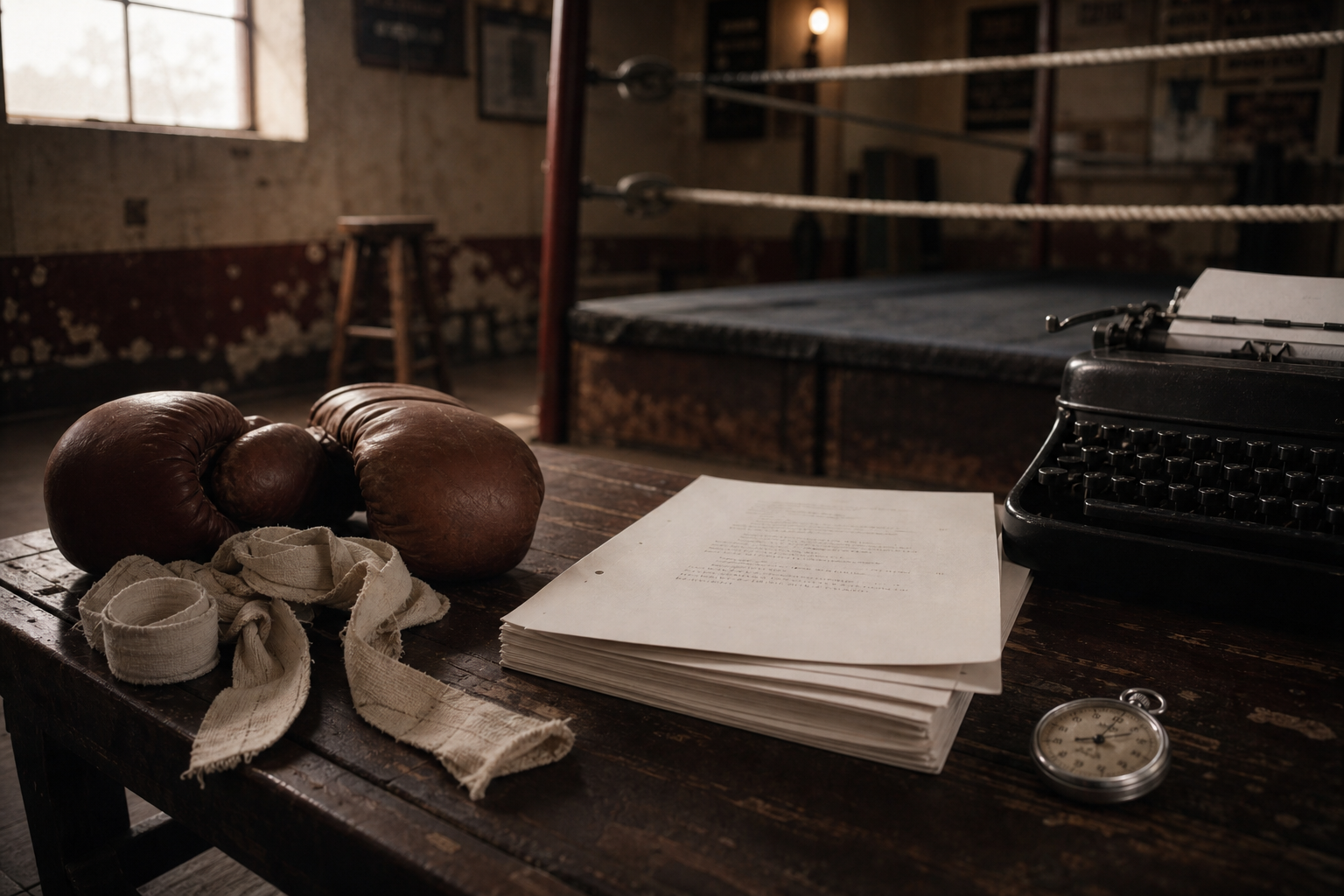
There is something suspiciously tidy about making an underdog movie about the making of the underdog movie. The boxer gets replaced by the screenwriter. The championship belt becomes the right to play the lead. The intimidating opponent is no longer Apollo Creed; it is a room full of people saying, reasonably, that the unknown writer may not also be the unknown star.
That is the loop at the center of I Play Rocky, Amazon MGM Studios’ scripted drama about Sylvester Stallone trying to get the original Rocky made. Its trailer treats Hollywood history like a rematch: one more stubborn outsider, one more impossible-looking bet, one more flight of stairs—except this time the stairs lead to a casting decision.
Call it Rocky 0
I Play Rocky is not returning to Philadelphia to ask whether Rocky can still take a punch. It is going back to the moment before Rocky existed, when Stallone had a script, very little leverage, and an inconvenient condition: if the screenplay sold, he wanted the lead.
That makes the central struggle wonderfully small and enormous at once. No heavyweight title is on the line. The decisive contest is whether a creator can remain attached to his own idea when the sensible business move is to take the money and let somebody more bankable wear the gloves. The trailer compresses that fight into the language of a sports movie because, frankly, history left it the perfect equipment.
Before the outcome became inevitable
The original Rocky opened in New York on November 21, 1976. Stallone wrote it and starred in it; John G. Avildsen directed it. At the 1977 Academy Awards, the film received 10 individual nominations across nine categories and won three, including Best Picture and Directing. Fifty years later, the outcome is so familiar that failure can feel retroactively impossible.
That is the new film’s first problem and best trick. We know the bet pays off. We know the music will eventually swell in the culture, whether or not it swells in this particular trailer. Suspense has to come from recovering the period when none of that was guaranteed. I Play Rocky therefore asks viewers to forget the franchise, the statue, and the victory laps long enough to see a screenplay that could still have become a polite rejection letter.
A five-step story that somehow ends by becoming its own origin story.
Anthony Ippolito has the trickiest kind of role
Anthony Ippolito plays the young Stallone, which sounds like an invitation to spend two hours doing a famous voice at a mirror. The trailer suggests a smarter target. Its job is not simply to reproduce a cadence, jawline, or workout posture. It has to make a familiar public figure feel unfinished—talented but unproven, recognizable but not yet protected by recognition.
Ippolito has already visited this strange profession. He played a young Al Pacino in The Offer, another drama about a celebrated film fighting its way into existence. In I Play Rocky, that experience becomes almost comically specific: he is once again portraying an actor before the world has agreed to see that actor as inevitable.
The supporting cast turns film history into a crowded backstage hallway: Stephan James plays Carl Weathers, Kiki Seto plays Talia Shire, Robert Morgan plays Burgess Meredith, and Jay Duplass plays Avildsen.
The involvement story has two corners
There is an off-screen wrinkle the trailer cannot settle. Stallone said in an October 2025 interview that he had no involvement with the production, though he sounded interested in offering insight. In April 2026, Farrelly gave a different account: he said the script had been sent to Stallone, that the two met, and that Stallone gave the project a go-ahead.
What we can safely say
Stallone is not publicly credited as a producer or consultant. Their accounts leave unresolved tension over his prior awareness and blessing; both indicate that he had no credited production role.
The tension is worth noting precisely because the movie concerns ownership, authorship, and the price of letting somebody else tell your story. It is also a reason to resist the easy headline that the film is definitively approved or defiantly unauthorized. Real life has declined to arrange itself into a clean three-act structure.
A trailer can sell the myth; the movie must find the person
The trailer’s pleasures are immediate. Typewriters clack. Doors close. Bodies train. Doubtful people doubt. An unreasonable man remains unreasonable until history changes the adjective to visionary. It is efficient, muscular mythmaking, and the story fits the machinery so perfectly that you can hear the montage warming up.
The finished film will need more than a victory lap. It has to make the stubbornness costly, the compromises visible, and the people around the hero more than obstacles positioned for him to overcome. Otherwise the underdog story becomes a foregone conclusion wearing hand wraps.
That is why I Play Rocky is interesting before anyone knows whether it is good. It is a film about a man betting that audiences would believe him as an underdog, made for audiences who can no longer remember a world in which that bet looked ridiculous. Peter Farrelly’s movie must restore the risk without pretending the ending is unknown.
One more climb, with the steps already famous
Amazon MGM plans to open the film in select theaters on November 6, 2026, before expanding it later in November. That places the release almost exactly half a century after the original film reached New York.
The timing is a celebration, but the concept is a dare. Rocky taught popular culture how to cheer for a long shot. I Play Rocky must make the making of that lesson worth dramatizing. For now, the trailer has managed the essential first round: it makes an ending everyone knows feel, briefly, like a bet again.