
The first software job has never been glamorous. It is usually a small kingdom of renamed variables, repaired tests, mysterious tickets, and reviews that politely translate to: “Please try again without setting the building on fire.” These modest assignments are how a beginner turns syntax into judgment.
Generative AI is unusually good at swallowing that kind of task. It can draft a function, explain a stack trace, write a test, and produce a confident paragraph about why all three are correct. That does not mean the software job is disappearing. The more interesting possibility is that its first rung is being quietly removed while the rest of the ladder remains upright.
The job count is not the scary part
The loud version of this story says artificial intelligence will delete the programmer. The numbers are less cinematic. The US Bureau of Labor Statistics projects software-developer, quality-assurance, and tester employment to grow 15 percent from 2024 to 2034, with roughly 129,200 openings a year. LinkedIn’s 2026 software-engineer review likewise found little evidence that AI had displaced software engineers as a broad occupation.
There is still a change inside those totals. LinkedIn reported weaker momentum for entry-level hiring in AI-augmented roles and a smaller share of computer-science graduates entering traditional software-engineering jobs. Its interpretation is cautious: hiring has slowed, not collapsed.
So the useful question is not whether software survives. It is whether the route into software becomes narrower, stranger, and more demanding before anybody updates the map.
The first rung is made of boring little tasks
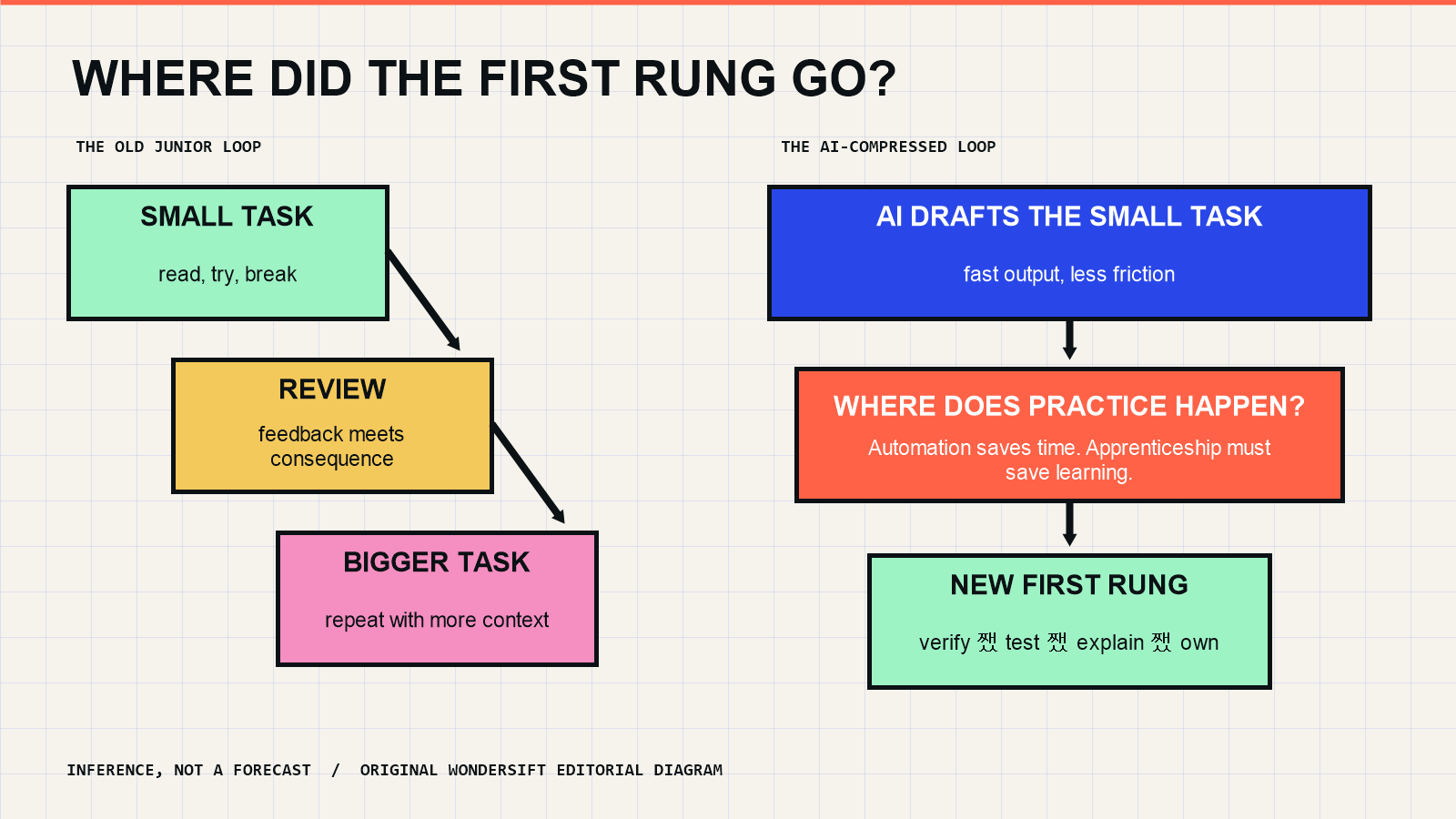
Nobody frames “rename this variable” as a heroic quest. Unfortunately, careers are built from unheroic quests. A junior learns the codebase by fixing the tiny bug. The test failure teaches where assumptions live. The review teaches that technically valid code can still be unreadable, fragile, or wrong for the product.
These jobs create fast feedback with limited blast radius. A beginner can be wrong cheaply, meet the consequence, and try again. Dozens of small corrections become the instinct senior developers call experience.
If an AI assistant performs the first draft, the diagnosis, and the test scaffold, the team may finish faster. It may also remove three encounters that would have taught the newcomer why the answer works.
AI is very good at eating practice
Anthropic’s analysis of software-development conversations found Claude Code usage leaning heavily toward automation, although review and iteration remained common. GitHub’s controlled Copilot study found participants completing a bounded JavaScript task 55 percent faster. Both results help explain why a manager might hand routine implementation to a tool before handing it to a new hire.
But a faster draft is not a trained developer. The model does not build a career from the review comment it receives. Humans do.
This is the first-rung problem: the work easiest to automate overlaps with work that was useful precisely because a beginner had to struggle through it.
Faster is real, but not universal
Productivity evidence refuses to behave like a slogan. GitHub’s experiment showed a large speed gain on one well-defined task. A 2025 randomized study by METR found experienced open-source developers took 19 percent longer with early-2025 AI tools on issues in repositories they knew well. METR later said its follow-up could not produce a reliable new effect size because participation and time measurement had become harder to interpret.
Those findings describe different tools, tasks, and people. AI can be excellent when a problem is bounded and verification is cheap. It can become a detour when context is deep or correctness is slippery.
The apprentice therefore needs more than prompt fluency. They need enough knowledge to recognize when the shortcut has delivered them efficiently to the wrong address.
A new apprentice contract
Employers are already describing a hybrid future. The World Economic Forum’s employer survey places software developers among fast-growing roles while also reporting plans to hire AI-skilled workers, retrain staff, and redesign work. LinkedIn finds rising demand for AI and cloud skills rather than a clean substitution of bots for engineers.
The response is not to preserve every tedious ticket in amber, but the learning hidden inside it. Let a junior use AI to draft a patch, then predict failure modes. Make them write the test that could embarrass it, explain the data flow, and defend the trade-off to a human reviewer.
That changes the first assignment from “type the code” to “prove the code deserves to exist.” It is harder, but it is also closer to the work a strong engineer eventually performs.
Keep the rung, change what it teaches
AI may not remove the first rung everywhere. Hiring cycles, company size, geography, and tool adoption all matter. The current evidence supports a risk, not a universal verdict. Still, waiting for perfect statistics would be a curious way to run an apprenticeship program.
Teams can measure whether juniors receive progressively harder ownership, not merely more output. Schools can teach review, debugging, architecture, security, and communication alongside generation. New developers can keep a practice budget: sometimes use the assistant, sometimes solve without it, and always learn how the answer fails.
The ladder does not need a museum-quality replica of 2019. It needs a reachable beginning. If AI takes the chores, humans must redesign the practice. Otherwise the industry may discover that it automated the work of becoming good while continuing to advertise jobs for people who already are.
Sources
- US Bureau of Labor Statistics: Software Developers, Quality Assurance Analysts, and Testers
- LinkedIn Economic Graph: US Software Engineer Talent Landscape 2026
- LinkedIn Economic Graph: AI Labor Market Update, April 2026
- Anthropic Economic Index: AI’s impact on software development
- METR: Early-2025 AI on experienced open-source developer productivity
- GitHub Research: Quantifying Copilot’s impact on a bounded coding task
- World Economic Forum: Future of Jobs 2025 workforce strategies
Related reading
Open models change who can inspect, adapt, and run the machinery underneath an AI product.
The AI Model Has Left the Building. It Took the Weights With It. →
Keep sifting
Browse WonderSift’s daily editions, explainers, and durable tools in one place.